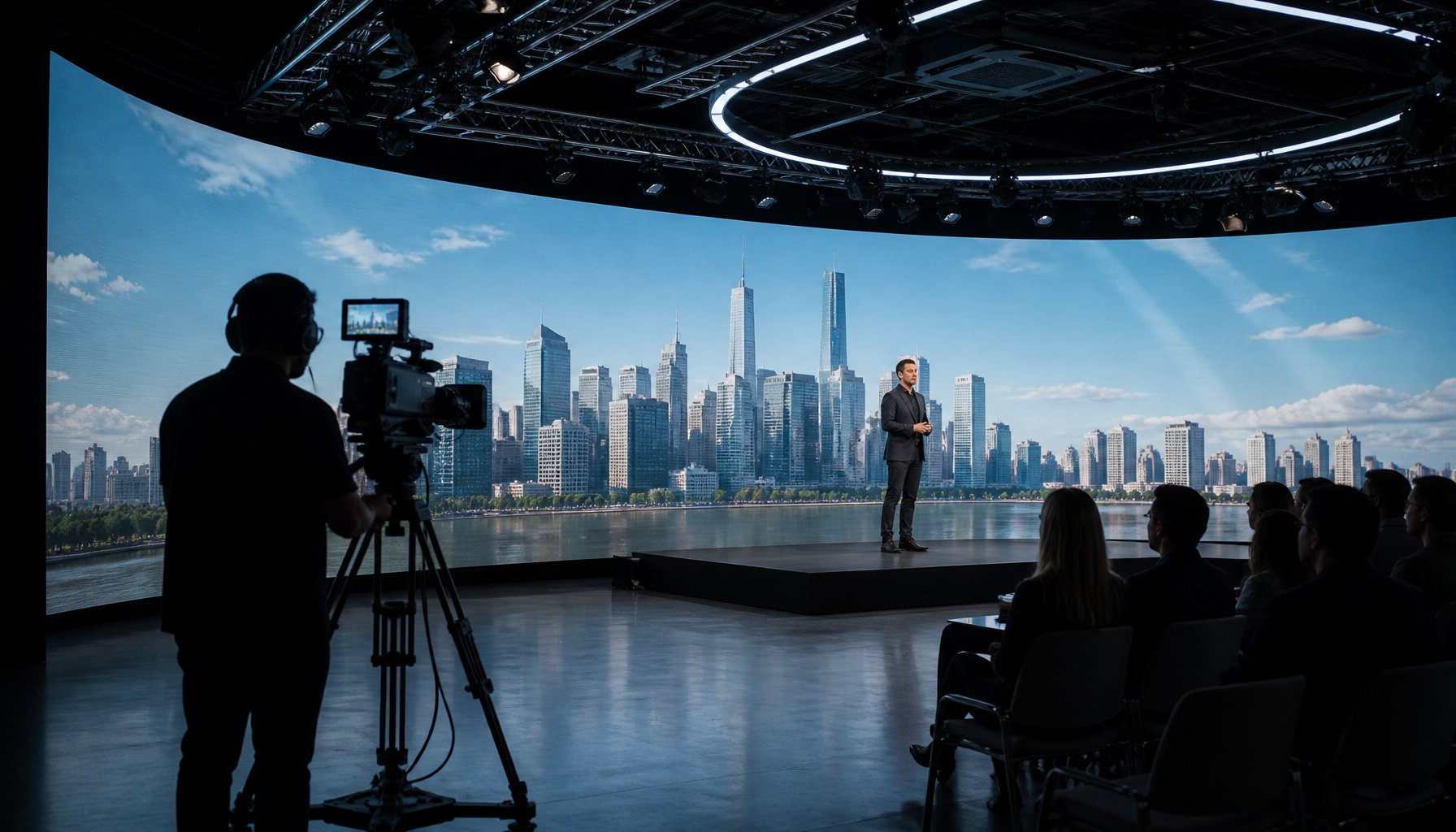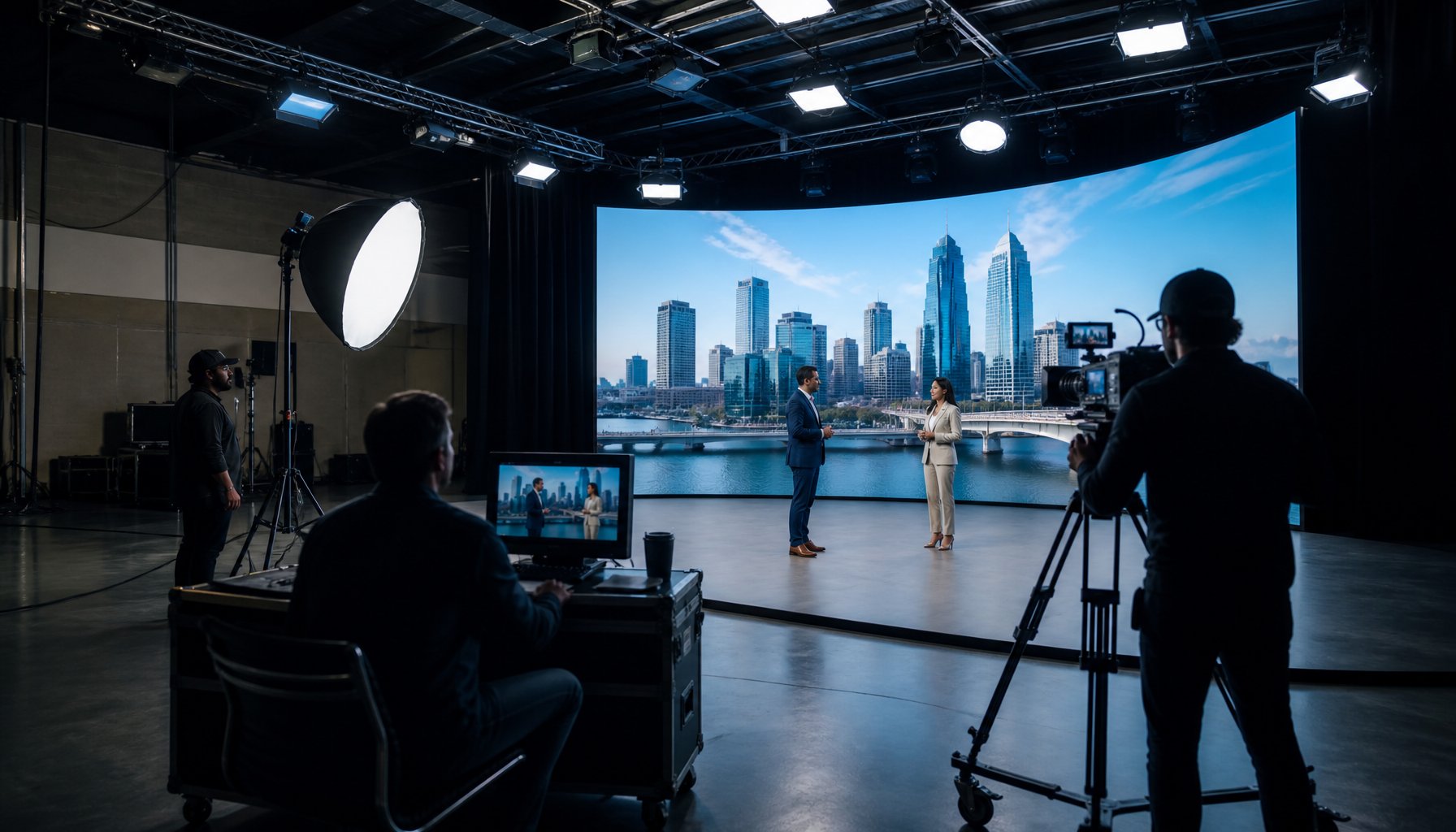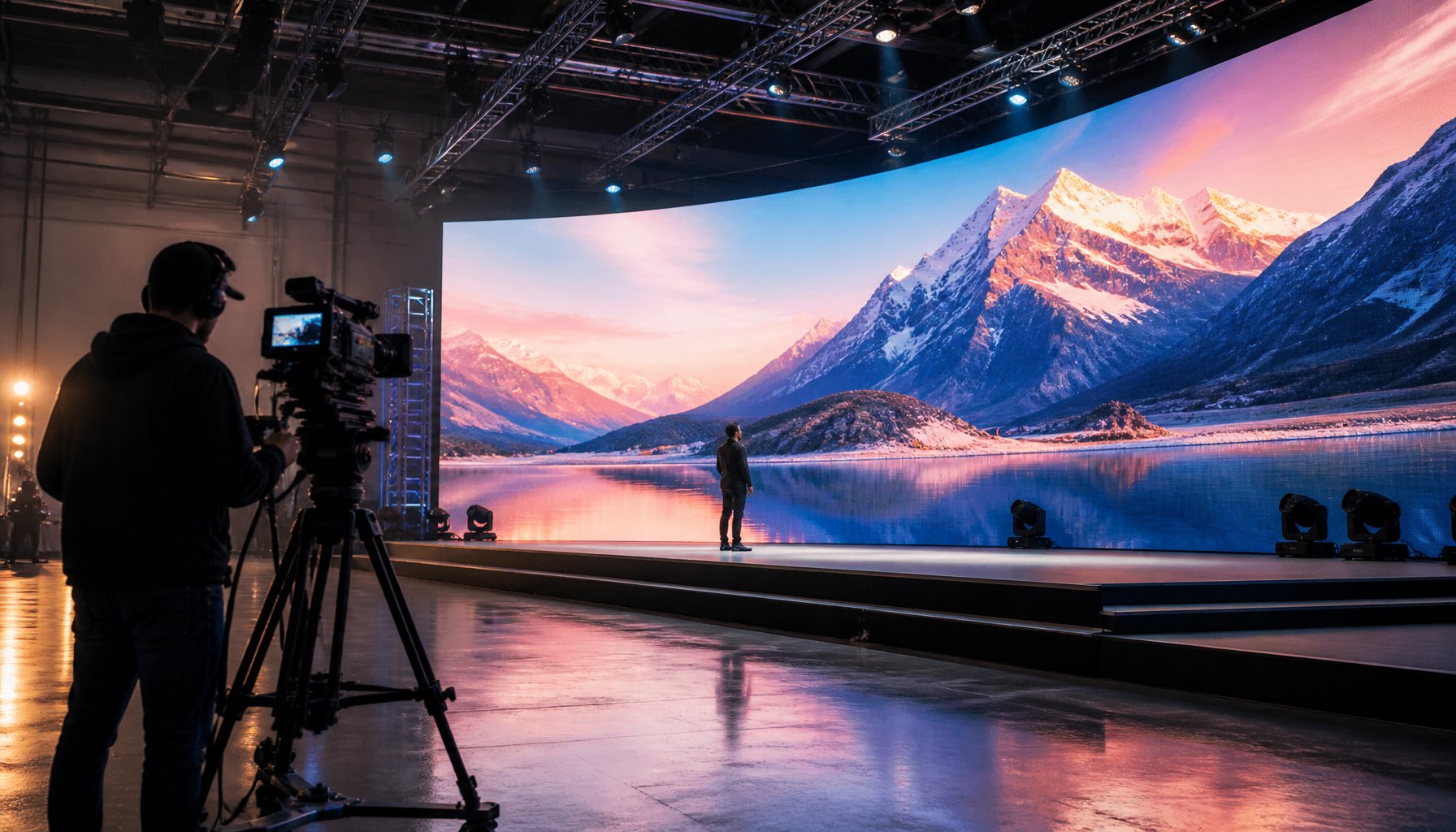
Your last corporate keynote probably looked like every other corporate keynote: a stage, a podium, a PowerPoint deck projected onto a screen behind the speaker. The audience politely watched, checked their phones, and forgot most of it by lunch. That is the reality most event planners face — and it is exactly why virtual production for corporate events is rapidly becoming the new standard for organizations that refuse to settle for forgettable. According to a 2025 report from Grand View Research, the global virtual production market is projected to grow at a compound annual growth rate of over 17% through 2030, driven largely by corporate and enterprise adoption outside Hollywood. Corporations in Washington DC, Northern Virginia, and beyond are discovering that LED wall technology does not just make events look cinematic — it fundamentally changes how audiences engage with the message.
Why Corporate Events Are Broken — and How Virtual Production Fixes Them
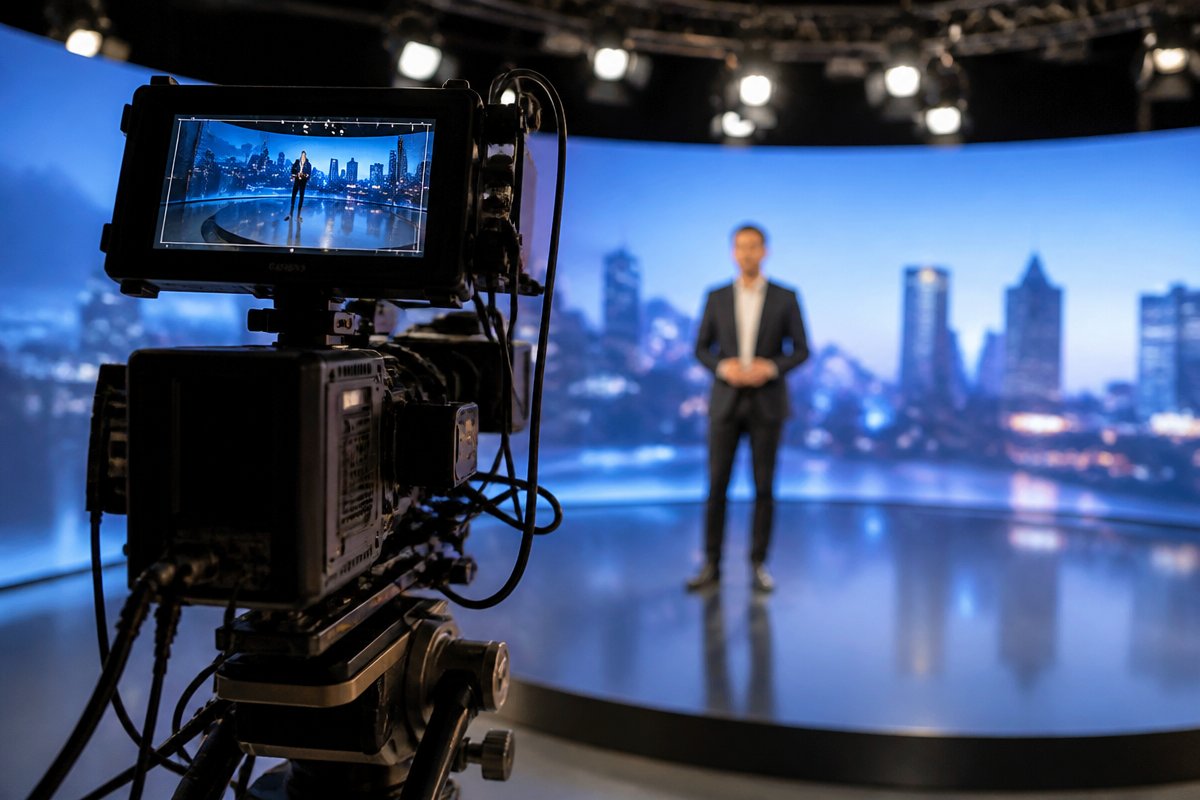
Let us be honest about the current state of corporate events. Whether it is a product launch, a quarterly town hall, or an annual leadership summit, the format has barely evolved in decades. Speakers stand in front of static slides. Stage design is limited by physical set construction budgets. And remote attendees — now a permanent fixture of the hybrid workforce — get the worst experience of all: a flat camera feed of someone talking at a lectern.
Virtual production changes every one of these dynamics. By placing speakers on a stage surrounded by high-resolution LED video walls, organizations can create any environment in real time. A pharmaceutical company launching a new drug can immerse the audience in a 3D visualization of cellular biology. A tech firm announcing a platform update can surround the CEO with a dynamic, data-driven cityscape. A government agency conducting an all-hands meeting can brand every inch of the visual environment without building a single physical set piece.
The shift is not just aesthetic. It is strategic. When the visual environment responds to the content — when backgrounds change with each segment, when graphics wrap around the speaker rather than sitting on a flat screen behind them — audiences pay attention. Retention improves. Emotional impact increases. And the resulting video content is exponentially more shareable and repurposable than a standard event recording.
Real Use Cases: How Organizations Are Using LED Wall Virtual Production
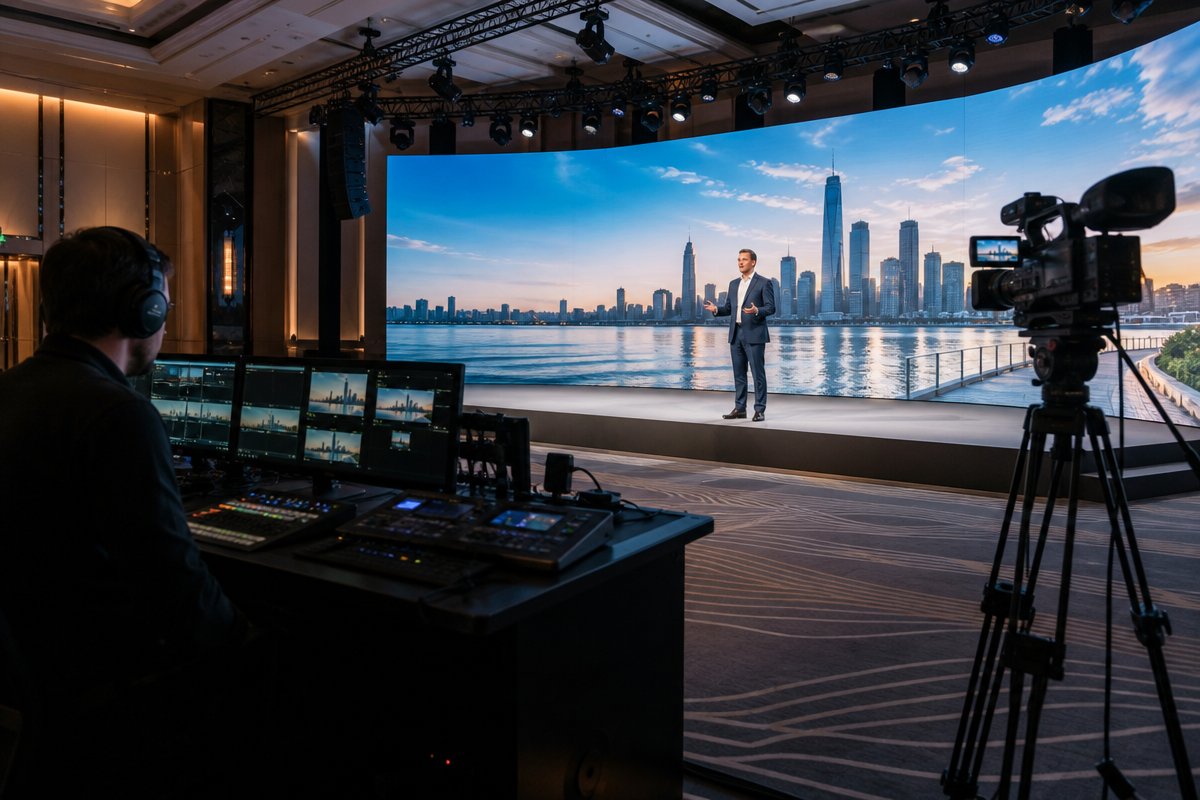
The best way to understand the power of virtual production for corporate events is to see how real organizations are putting it to work. Below are the most common and impactful use cases we see across industries in the DC metro area and beyond.
Executive Keynotes and Leadership Addresses
Gone are the days when a CEO could command attention simply by walking onstage. Today’s audiences — internal and external — expect production value. With LED wall virtual production, executive keynotes become immersive experiences. The speaker can be surrounded by branded environments, dynamic data visualizations, or even virtual locations that reinforce the narrative. One moment the CEO is standing in the company’s flagship office; the next, the background shifts to a construction site showing a new facility under development. All of it happens in-camera, in real time, with no post-production compositing required.
Product Launches and Demonstrations
Product launches demand spectacle and clarity in equal measure. Virtual production delivers both. Imagine unveiling a new software platform while the LED walls behind and beside the presenter display the product interface at massive scale, animated and interactive. Or launching a physical product — a vehicle, a medical device, a consumer gadget — within a photorealistic environment that would have been impossible or prohibitively expensive to build as a physical set. The product becomes the hero of a cinematic moment, not just a bullet point on a slide.
Town Halls and All-Hands Meetings
Internal communications teams are under more pressure than ever to keep distributed workforces engaged. A town hall filmed in a virtual production studio feels dramatically different from a Zoom call or a basic auditorium recording. Segment transitions become visual events. Department updates can each have their own branded environment. Q&A sessions feel like broadcast television. The result is that employees actually watch — and more importantly, they remember what was said.
Investor Days and Shareholder Presentations
For publicly traded companies and organizations courting major investors, perception matters. Virtual production elevates investor-facing events to broadcast quality, signaling sophistication and forward-thinking leadership. Financial data can be displayed dynamically across the LED environment, and the overall production quality reinforces confidence in the organization’s capabilities.
Award Ceremonies and Recognition Events
Whether honoring employees, partners, or community leaders, award ceremonies benefit enormously from the visual flexibility of LED walls. Each award segment can feature unique environments, video tributes can play seamlessly behind presenters, and the entire event feels polished and intentional — like a branded broadcast rather than a conference room gathering.
What Makes Virtual Production Different from Traditional Event AV
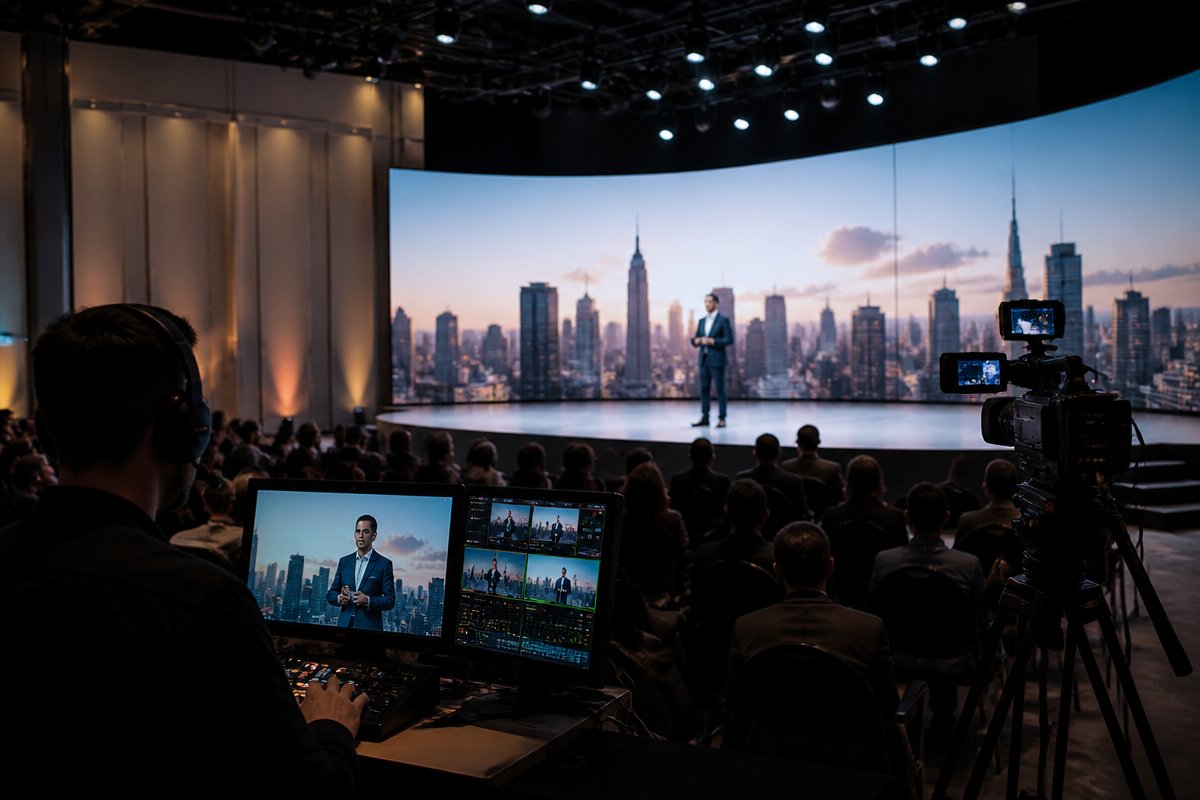
It is important to distinguish virtual production from standard audiovisual setups. Many event planners are accustomed to working with AV companies that provide projection screens, basic LED panels for logo display, and camera coverage. Virtual production is a fundamentally different discipline, and understanding the distinction is critical before investing.
In-Camera Visual Effects
The defining characteristic of LED wall virtual production is that the visual environment is captured in-camera. The LED walls display high-resolution content that the camera sees and records as if it were a real environment. There is no green screen. There is no post-production keying or compositing. What the camera captures on set is essentially the final image. This saves enormous time in post-production and produces results that look more natural and convincing than traditional chroma key approaches.
Real-Time Content Control
Unlike pre-rendered video playback on a projection screen, virtual production environments can be controlled and adjusted in real time. Using game engine technology — typically Unreal Engine — the production team can modify lighting, camera angles within the virtual environment, animated elements, and background content on the fly. This means the event can adapt in real time to script changes, audience reactions, or creative decisions made in the moment.
Integrated Lighting and Reflections
One of the most underappreciated advantages of LED wall stages is that the walls themselves become the lighting source. The colors and brightness of the virtual environment naturally illuminate the speaker, creating realistic reflections, color casts, and ambient lighting that would be impossible to replicate with green screen and post-production alone. This is why virtual production footage looks so much more believable than traditional composited video.
Planning a Corporate Event with Virtual Production in Washington DC
If your organization is considering virtual production for an upcoming corporate event in the Washington DC, Northern Virginia, or Maryland area, the planning process differs significantly from a traditional event production workflow. Here is what to expect.
1. Strategic Pre-Production
Every successful virtual production event begins with a clear understanding of the message, the audience, and the desired outcome. This is not just about choosing cool backgrounds. The virtual environments need to serve the narrative. Pre-production involves:
- Defining the event structure, segments, and speakers
- Developing a creative concept for the virtual environments
- Designing and building 3D assets and scenes in Unreal Engine or similar platforms
- Planning camera positions, lighting design, and LED wall content mapping
- Coordinating with speakers on blocking and presentation flow
2. Studio Selection and Technical Setup
Not every LED wall setup is suitable for virtual production. The stage needs to be purpose-built or properly configured with the right pixel pitch, color accuracy, refresh rate, and curvature to create a convincing in-camera effect. Working with a production partner that owns and operates its own virtual production stage ensures technical reliability and creative flexibility.
3. Rehearsal and Technical Checks
Virtual production events require rehearsal time — more than a standard corporate event. Speakers need to understand how to move within the LED volume. Camera operators need to calibrate tracking systems. The Unreal Engine team needs to confirm that all content plays back correctly and that transitions between segments are smooth. Budget for at least a half-day of technical rehearsal before any live or recorded event.
4. Execution and Live Direction
On the day of the event, the production team manages multiple workflows simultaneously: camera operation, LED wall content playback, real-time engine control, audio mixing, lighting adjustments, and — if the event is hybrid — live streaming to remote audiences. This requires a team with deep experience in both broadcast production and real-time virtual production technology.
5. Post-Event Content Repurposing
One of the most valuable aspects of producing a corporate event with virtual production is the volume of high-quality content it generates. A single keynote can yield:
- A full-length event recording for internal distribution
- Short highlight clips for social media
- Speaker-specific segments for individual department use
- Behind-the-scenes content showing the production process
- Thumbnail and still images extracted from the high-quality video feed
This content library extends the ROI of the event far beyond the day itself.
Choosing the Right Production Partner
Virtual production for corporate events is not a commodity service. The quality of the result depends entirely on the expertise and equipment of the production team. When evaluating potential partners, look for:
- Owned LED wall infrastructure: Companies that own their stages have greater control over quality, availability, and pricing than those renting third-party equipment.
- Unreal Engine expertise: The real-time environment is only as good as the team building and operating it. Look for demonstrated experience with real-time 3D content creation.
- Corporate event experience: Hollywood virtual production and corporate virtual production are different disciplines. Your partner needs to understand executive communication, brand standards, and organizational messaging — not just cinematography.
- End-to-end production capability: From pre-production planning through post-event content delivery, the best partners handle the entire workflow under one roof.
- Local presence and accessibility: For organizations in Washington DC, having a production partner with a local studio eliminates logistical complexity and travel costs.
Frequently Asked Questions
How much does virtual production for a corporate event cost?
Costs vary significantly depending on the scope of the event, the complexity of the virtual environments, the number of shooting days, and whether the event includes live streaming. A single-day corporate keynote with custom environments typically starts in the range of $15,000 to $50,000 or more. While this is higher than a basic stage-and-screen setup, the production value, content output, and audience engagement gains often deliver a stronger return on investment than traditional approaches.
Can virtual production support hybrid events with remote audiences?
Absolutely. Virtual production pairs exceptionally well with hybrid event formats. Because the in-camera output is already broadcast-quality, the live stream feed looks dramatically better than a standard camera-in-a-ballroom setup. Remote attendees receive a viewing experience that rivals — and sometimes exceeds — what in-person attendees see, which is critical for organizations with distributed teams.
How far in advance should we start planning a virtual production event?
We recommend beginning the planning process at least six to eight weeks before the event date for a standard corporate keynote or town hall. More complex events — multi-day conferences, product launches with elaborate virtual environments, or events requiring custom 3D asset creation — may need three months or more of lead time. The earlier the creative and technical planning begins, the better the final result.
Do speakers need special training to present on a virtual production stage?
Speakers do not need extensive training, but a rehearsal session is essential. Unlike green screen, where the speaker cannot see the environment around them, LED wall virtual production allows presenters to see the virtual background in real time. This makes it easier and more natural to present. However, speakers do need to understand basic blocking — where to stand, how far to move, and how to interact with on-screen content. A 30- to 60-minute rehearsal typically addresses all of these needs.
What types of virtual environments can be created?
Virtually anything. Common corporate environments include branded stages, futuristic cityscapes, nature settings, abstract data visualizations, product showcases, and photorealistic recreations of real locations such as office headquarters, manufacturing facilities, or global landmarks. Environments can be fully custom or adapted from existing 3D asset libraries to manage costs and timelines.
Is virtual production only for large corporations?
Not at all. While Fortune 500 companies and government agencies were early adopters, mid-sized organizations, nonprofits, and growing companies are increasingly using virtual production for events, fundraisers, and communications. The technology has become more accessible, and working with a production partner that scales solutions to different budgets makes it viable for a wider range of organizations than ever before.
The Standard Has Changed — Has Your Event Strategy?
The era of podiums and PowerPoints is not over, but it is no longer enough. Audiences — whether they are employees, investors, customers, or stakeholders — have been conditioned by high-quality media to expect more. Virtual production for corporate events delivers that more: more visual impact, more audience engagement, more usable content, and more return on every dollar spent on event production.
If your organization is planning a keynote, product launch, town hall, or leadership event in Washington DC, Northern Virginia, Maryland, or the surrounding region, TriVision Studios operates a full-service virtual production stage with LED wall technology, Unreal Engine capability, and a team that understands corporate communication at every level. We have earned the trust of leading brands, government agencies, and nonprofits by delivering production quality that elevates the message — not just the visuals.
Contact TriVision Studios to discuss how virtual production can transform your next corporate event.