You’ve Heard the Buzz — But What Is Virtual Production, Really?
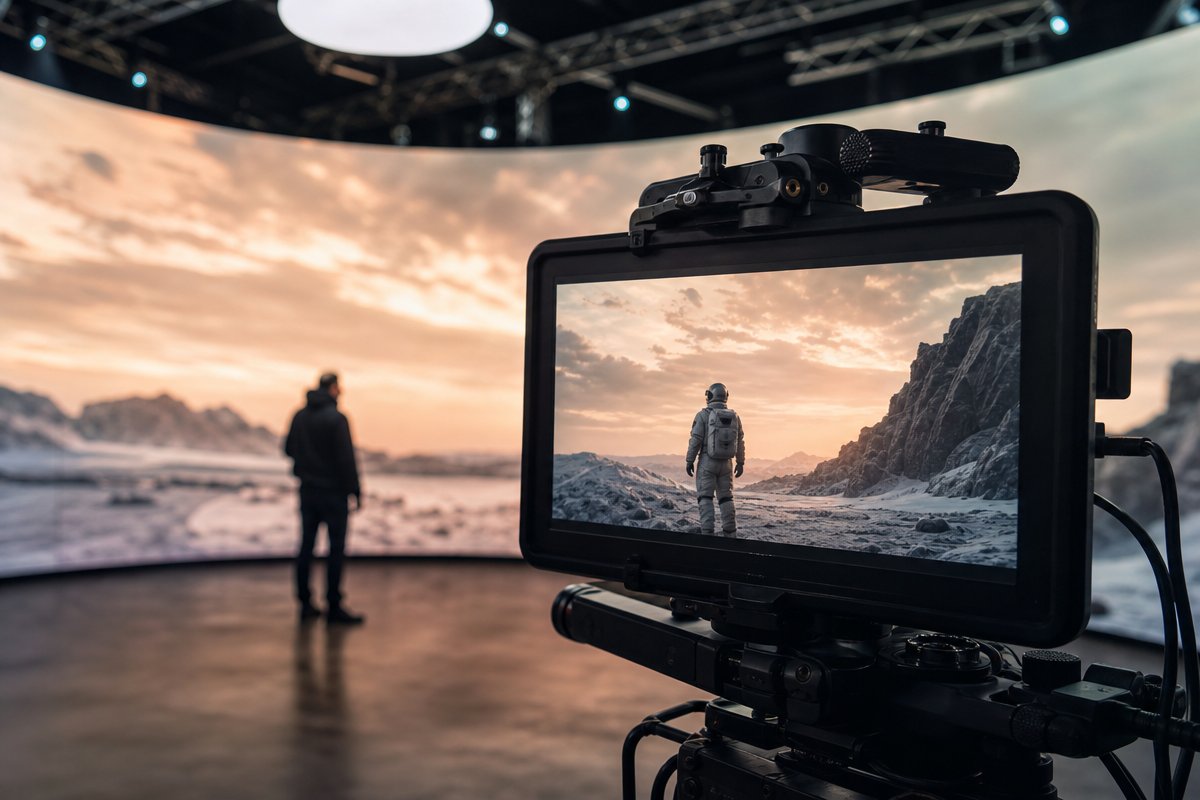
If you’re a marketing director, agency producer, or communications lead who has been hearing the term virtual production everywhere lately, you’re not alone — and you’re not behind. The technology has moved from Hollywood blockbusters into the mainstream business world faster than almost anyone predicted. According to a 2025 report from Grand View Research, the global virtual production market is projected to reach $4.73 billion by 2030, growing at a compound annual rate of over 14%. That kind of growth signals something important: this isn’t a novelty. It’s the future of how professional video content gets made.
But for decision-makers who aren’t steeped in production jargon, the concept can feel opaque. What exactly happens inside a virtual production studio? How is it different from a green screen? And most importantly — is it relevant to your organization’s video needs?
This guide breaks it all down in plain language. By the end, you’ll understand the core technology, the typical workflow, the industries benefiting most, and how to evaluate whether virtual production belongs in your next project’s playbook.
What Is Virtual Production? The Core Concept Explained
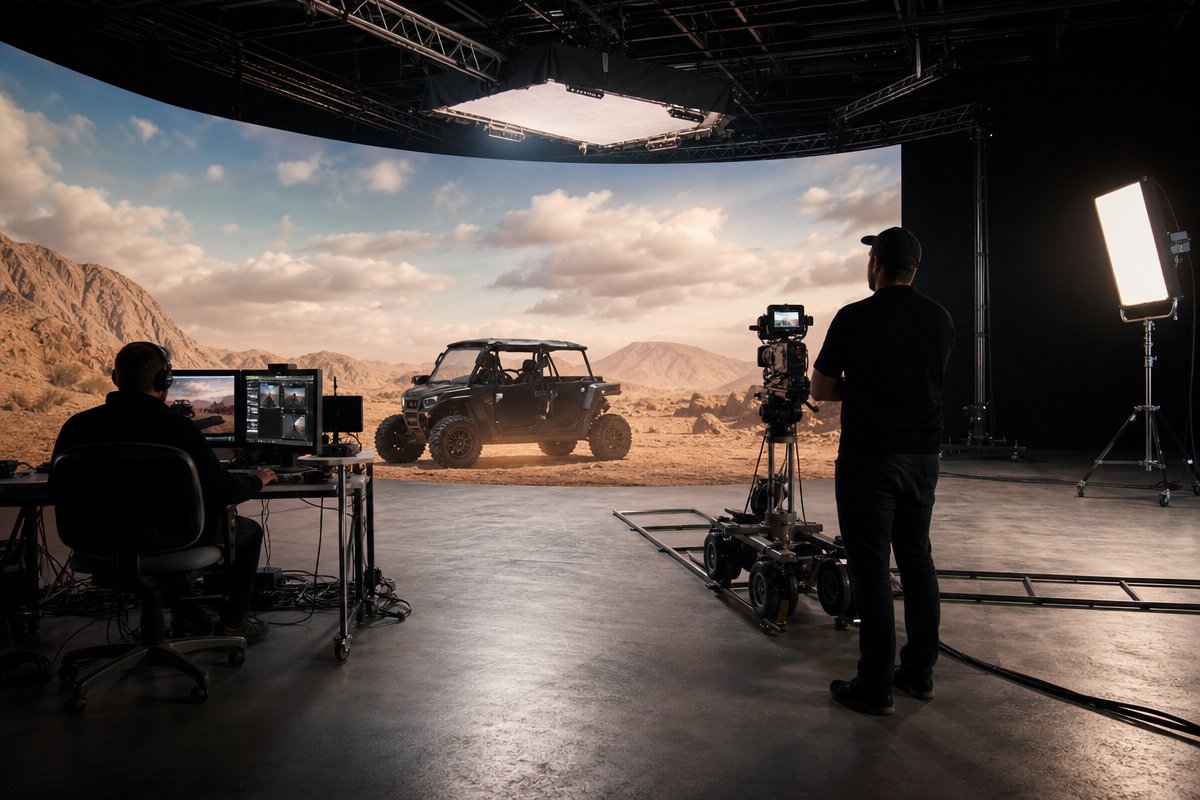
At its simplest, virtual production is a filmmaking approach that combines physical, real-world elements (actors, props, a physical set) with digital, computer-generated environments — and it does so in real time, on set, rather than months later in a post-production suite.
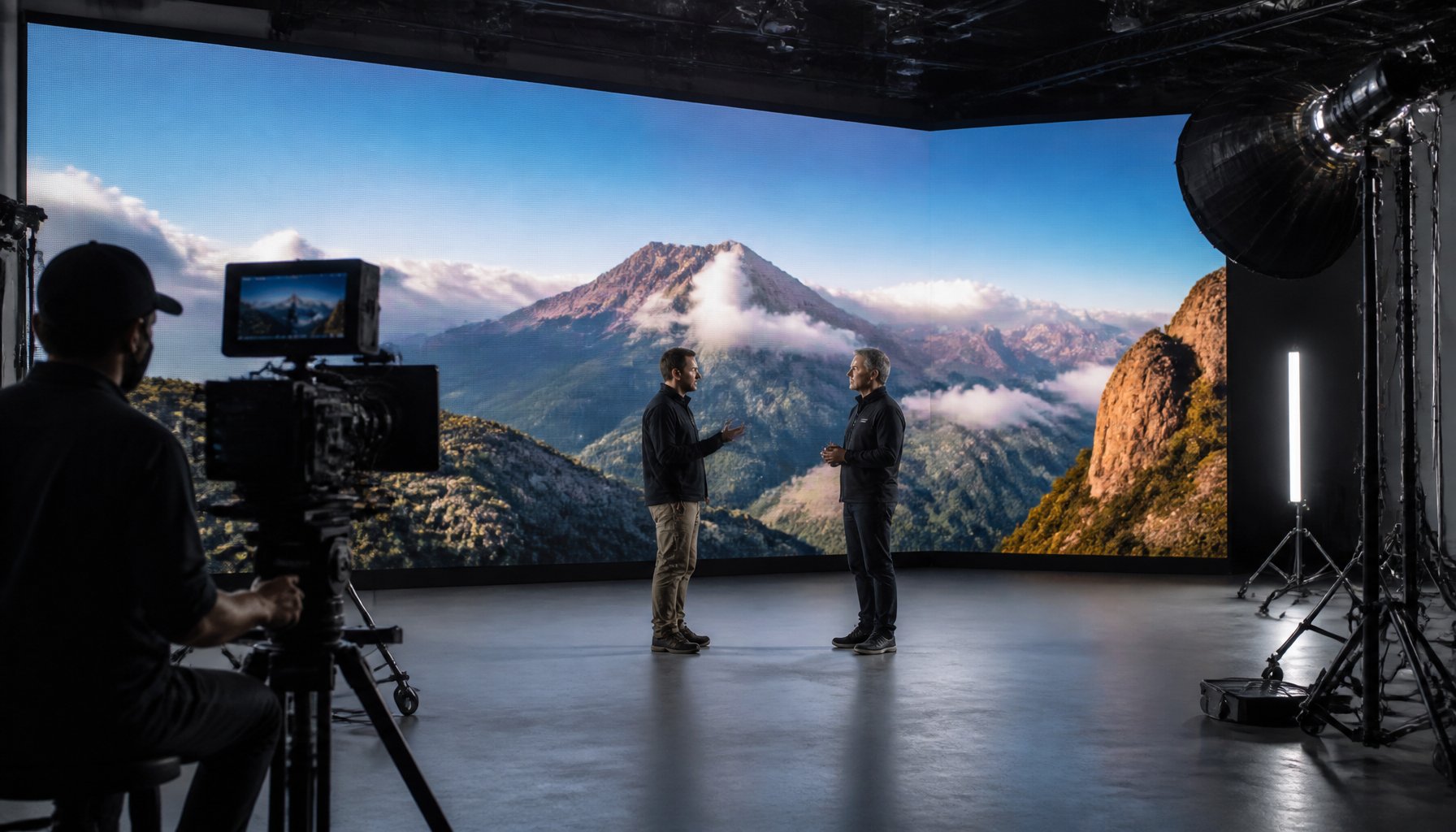
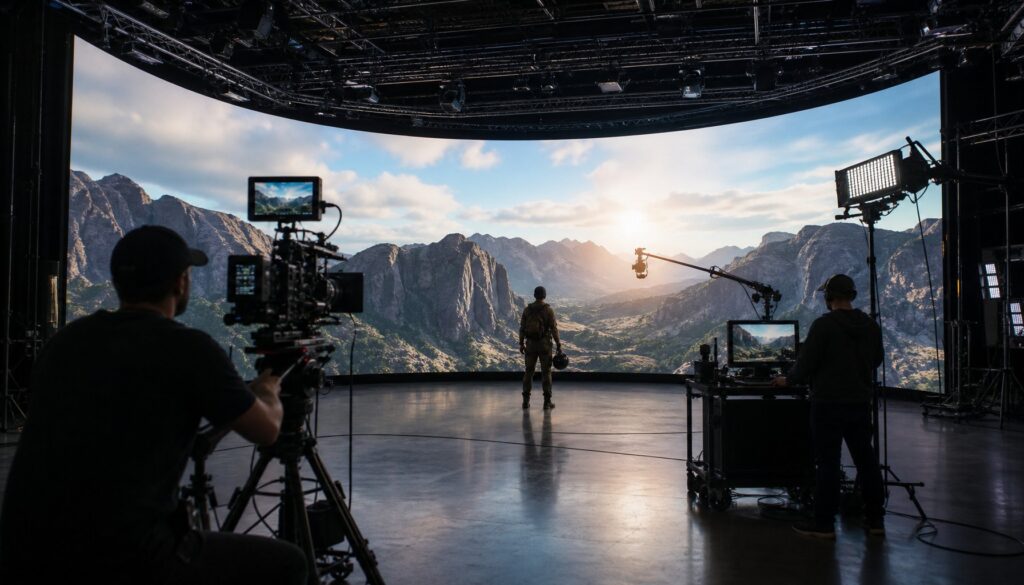
The most recognizable form of virtual production today uses a massive, curved LED video wall — sometimes called an LED volume — to display photorealistic digital backgrounds behind the talent. Unlike a green screen, where the background is added after the shoot, an LED wall displays the final environment during filming. The camera captures everything in a single pass: the actor, the set pieces, and the digital world behind them, all composited together live.
The Key Technologies Behind It
- LED Wall (LED Volume): A high-resolution display surface that wraps around the stage, projecting environments that react to camera movement in real time.
- Real-Time Rendering Engine: Software like Unreal Engine generates and updates the 3D environment frame by frame, matching the camera’s perspective so parallax and lighting feel natural.
- Camera Tracking: Sensors track the exact position and angle of the camera, feeding that data back to the rendering engine so the digital background shifts correctly — just as a real background would.
- Content Management: Pre-built 3D assets, HDRI environments, and custom-designed virtual sets are loaded into the system and can be swapped or adjusted on the fly.
When these systems work in concert, the result is extraordinary: talent appears to be standing in a corporate lobby in Tokyo, on a rooftop in Manhattan, or inside a futuristic data center — all without leaving the studio.
How Virtual Production Actually Works: A Step-by-Step Workflow
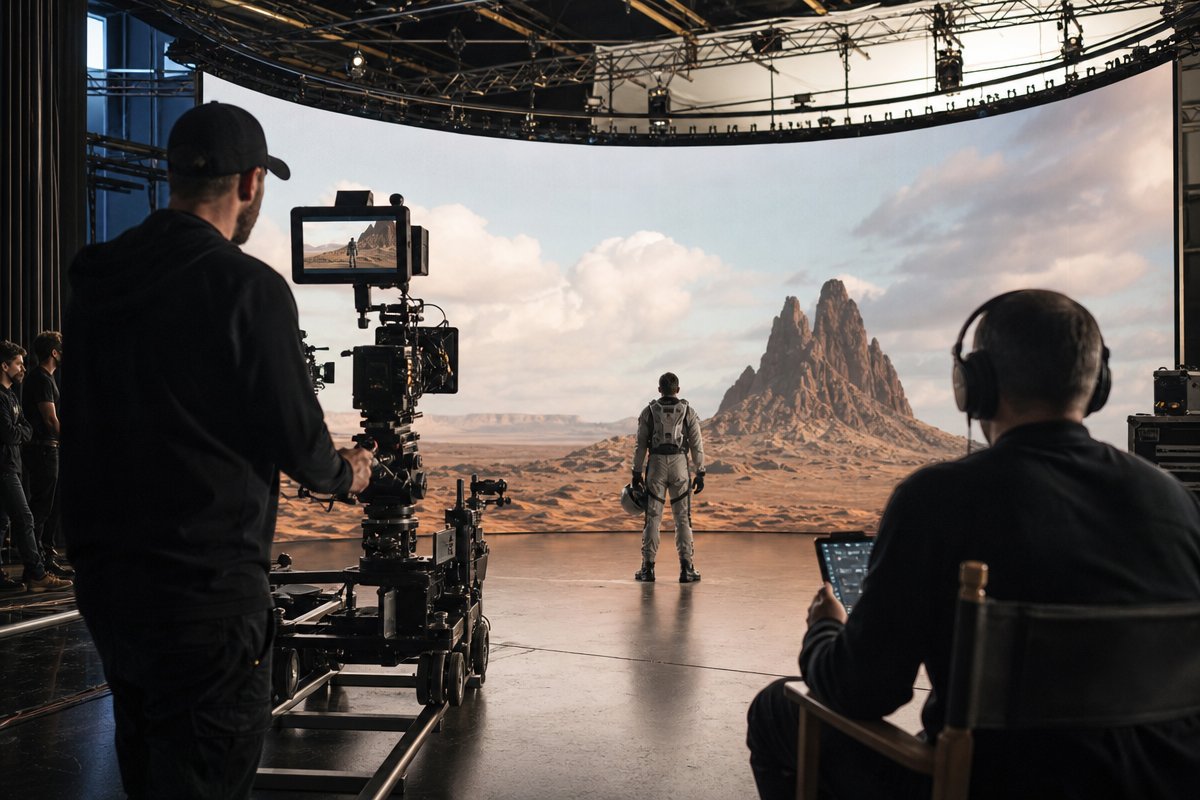
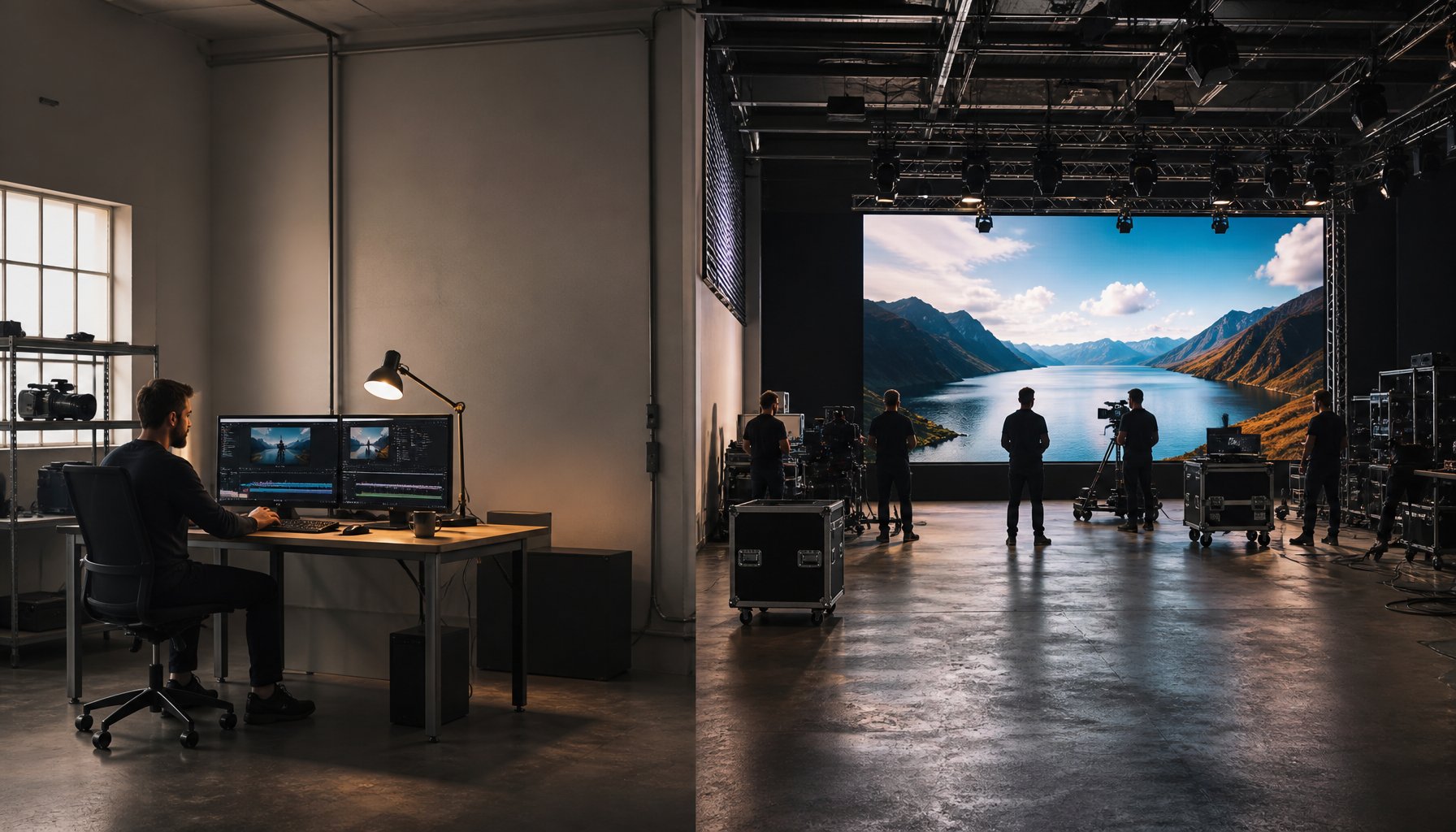
Understanding the workflow helps demystify what happens before, during, and after a virtual production shoot. Here’s how a typical project unfolds.
1. Pre-Production & Virtual Environment Design
Before anyone steps on set, the creative team collaborates with the client to define the visual worlds needed. This includes:
- Selecting or building 3D environments that match the creative brief
- Designing lighting schemes that will integrate naturally between the physical set and the LED wall
- Storyboarding camera movements to take full advantage of the immersive backdrop
- Running technical rehearsals to calibrate color, brightness, and tracking accuracy
This phase is critical. Unlike traditional location shoots, most creative decisions about the environment are made before the shoot day — which actually gives directors and stakeholders more control, not less.
2. The Shoot Day
On set, the LED wall is already displaying the chosen environment. Talent performs in front of it, and the production crew captures footage using standard cinema cameras equipped with tracking sensors. Key advantages during the shoot include:
- Instant feedback: Everyone on set — including the client — can see the final composite in real time on the monitor. No guessing what the green will be replaced with later.
- Rapid scene changes: Switching from a cityscape to a forest to a branded environment can happen in minutes, not hours.
- Natural lighting integration: The LED wall itself emits light that wraps around the talent, creating realistic reflections, color spill, and ambient lighting that would be extremely difficult to replicate in post.
3. Post-Production
Because so much of the compositing happens in-camera, post-production timelines are often significantly shorter than traditional green screen workflows. Editors still handle color grading, audio mixing, graphics, and final polish — but they’re not spending weeks rotoscoping edges or matching lighting between a filmed subject and a digitally added background.
Virtual Production vs. Traditional Methods: Why It Matters
To appreciate what virtual production offers, it helps to compare it against the two approaches it most often replaces.
Virtual Production vs. On-Location Shoots
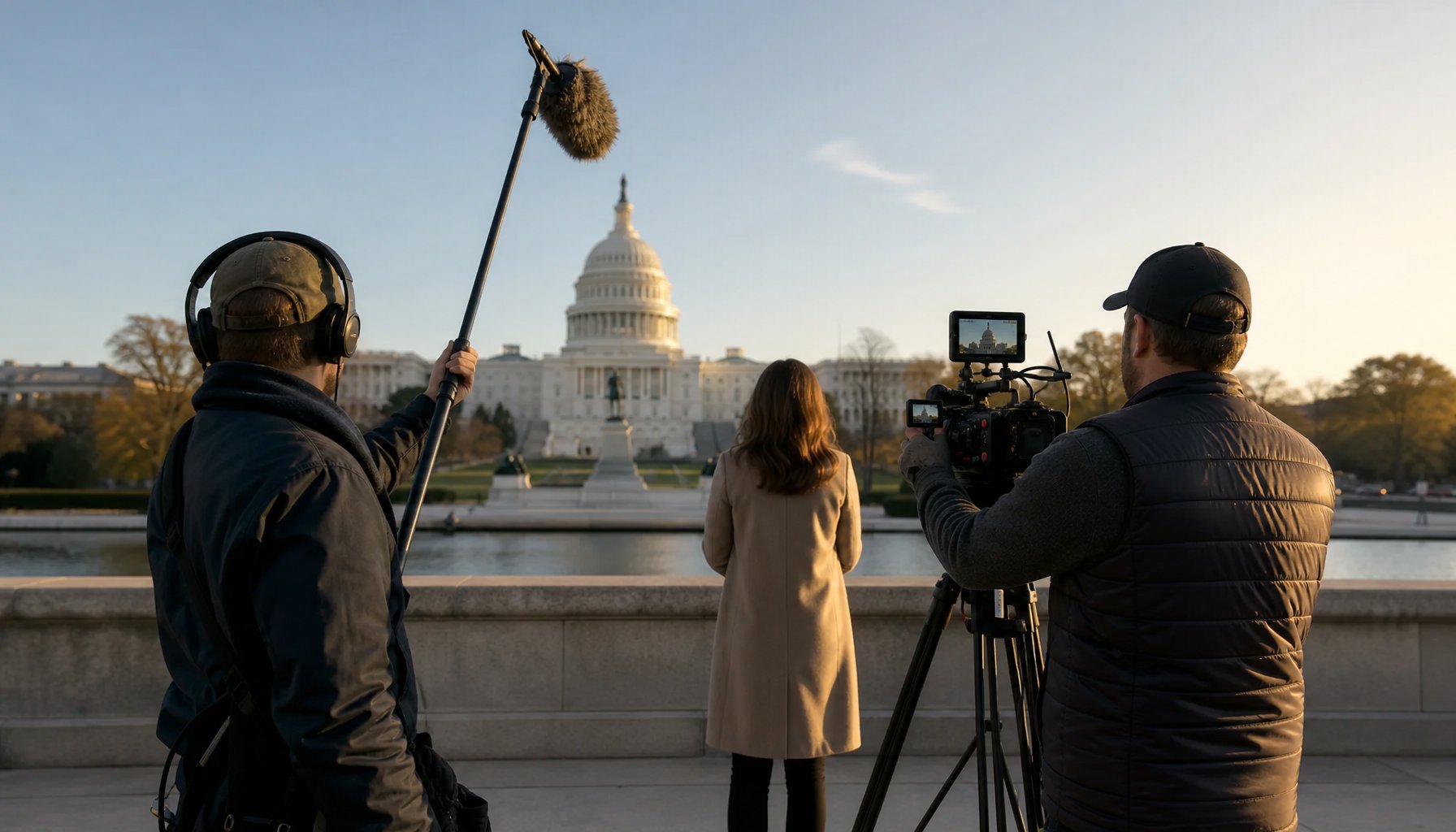
Shooting on location gives you authenticity, but it comes with logistical headaches: permits, travel costs, weather delays, crowd control, and limited shooting windows. Virtual production eliminates most of these variables. Need a shot at the U.S. Capitol at golden hour? You can have it — on demand, without a permit, without waiting for weather, and without competing with tourists.
Virtual Production vs. Green Screen
Green screen has been a staple for decades, but it has well-known limitations. Talent can’t see their environment, which affects performance. Lighting mismatches are common. Fine details like hair and transparent objects create compositing nightmares. And the final look often feels slightly off — something viewers sense even if they can’t articulate it.
Virtual production solves these problems at the source. The environment is visible, the lighting is real (emitted by the wall itself), and the composite is captured in-camera. The result looks more cinematic and more believable — often indistinguishable from a location shoot.
Real-World Applications: Who’s Using Virtual Production in 2026?
Virtual production isn’t just for sci-fi films. Across Washington DC, New York City, Richmond, and Baltimore, organizations of all types are leveraging this technology for practical, high-impact video content.
Corporate & Brand Marketing
Companies are using virtual production to create polished brand videos, product launches, and executive communications where the backdrop needs to look premium without the expense or disruption of traveling to multiple locations. A financial services firm, for instance, can film a thought leadership series with a different world-class city skyline behind the speaker each episode — all shot in a single day.
Government & Federal Agencies
Government communicators face unique challenges: tight schedules, security considerations, and the need for visually credible content that reflects the seriousness of their mission. Virtual production allows agencies to create training modules, public service announcements, and recruitment content in controlled, secure environments without compromising on visual quality.
Healthcare & Pharmaceuticals
Healthcare organizations use LED wall environments to simulate clinical settings, patient scenarios, or data-rich backgrounds for educational content — all while maintaining HIPAA-compliant, controlled conditions on set.
Nonprofits & Advocacy Groups
For organizations telling stories that span geographies — global aid work, environmental conservation, policy impact — virtual production makes it possible to transport viewers to those locations without a documentary crew’s travel budget.
Education & Training
Schools, universities, and corporate training departments use immersive backgrounds to create engaging educational content that holds attention better than a talking head in front of a plain backdrop.
Is Virtual Production Right for Your Next Project?
Virtual production is powerful, but it isn’t the right tool for every job. Here’s a quick framework to help you evaluate fit:
Virtual production is likely a strong fit if:
- You need multiple environments or locations but have a limited travel budget
- Visual quality and brand perception are high priorities
- You want stakeholders to approve the look in real time, on set
- You’re producing a series and need consistent, repeatable setups
- Time-to-delivery is critical and you want to minimize post-production
A traditional approach may be better if:
- Authentic, documentary-style footage in real locations is the creative goal
- The project is a simple interview or testimonial that doesn’t require environment design
- Budget is extremely limited (though virtual production costs have dropped significantly)
The best production partners will help you make this decision honestly, steering you toward the approach that serves the project — not just the flashiest technology.
Frequently Asked Questions About Virtual Production
How much does virtual production cost compared to traditional video production?
Costs vary depending on the complexity of the environments, the length of the shoot, and the level of customization required. However, many organizations find that virtual production is cost-competitive with traditional approaches when you factor in eliminated travel, reduced location fees, shorter post-production timelines, and the ability to shoot multiple scenes in a single studio day. For a detailed look at pricing factors, it’s best to consult directly with a studio that operates an LED volume.
Do I need to understand 3D software or Unreal Engine to use virtual production?
Not at all. As the client, your role is to communicate your creative vision — the locations, moods, branding, and messaging you need. The production team handles all technical execution, from building or sourcing 3D environments to calibrating the LED wall and camera tracking systems. A good studio makes the process feel collaborative, not technical.
Can virtual production be used for live events or live streaming?
Yes. Virtual production technology integrates naturally with live streaming workflows. Presenters can deliver keynotes, panel discussions, or product reveals in front of dynamic, branded LED environments that are broadcast in real time. This is especially popular for hybrid events where the virtual audience experience needs to feel as polished as the in-room experience.
What kind of content works best with virtual production?
The technology excels at content where the environment matters to the story: brand films, commercials, training scenarios, executive communications, recruitment videos, PSAs, and episodic series. It’s also ideal when you need to depict locations that are difficult, expensive, or impossible to access — whether that’s a foreign country, a hazardous setting, or a futuristic concept.
How long does it take to prepare a virtual production shoot?
Pre-production timelines typically range from two to six weeks, depending on whether the project uses existing 3D environments or requires custom-built virtual sets. Simple setups using stock environments can be turned around quickly, while fully bespoke worlds take more design time. Your production partner should provide a clear timeline during the planning phase.
Is virtual production only available in Los Angeles or major film hubs?
Not anymore. Virtual production studios have expanded rapidly into markets like Washington DC, New York City, Richmond, and Baltimore. Studios in these regions serve the corporate, government, nonprofit, and agency clients who are driving much of the technology’s growth outside of Hollywood.
Take the Next Step With Virtual Production in DC
Understanding what virtual production is puts you ahead of most decision-makers who are still relying on outdated production methods. The technology is accessible, the costs are increasingly competitive, and the creative possibilities are genuinely transformative for organizations that need high-quality video content.
At TriVision Studios, we operate a full-service virtual production facility in the Washington DC area, serving clients across DC, Northern Virginia, Maryland, New York City, Richmond, and Baltimore. Our team guides you from concept through delivery — handling every technical detail so you can focus on your message.
Whether you’re exploring virtual production for the first time or ready to book your next shoot, get in touch with our team to discuss how this technology can elevate your organization’s video content.